Showing posts with label ANCSA. Show all posts

June 1, 2015

The Politics of Alaska Native Arts and Culture Panel NAISA 2015


The Native American and Indigenous Studies Association (NAISA) 2015 Annual Meeting takes place from June 4-6 in Washington, DC, brought to life hosted by the National Congress of American Indians and other regional institutions. This year there are panels dedicated to Alaska Native Studies with other Alaska Native studies scholars in mixed panels. As 40 percent of the nation's tribes, I'm thrilled to see at all this work at the conference this year. Alaska specific things bolded, below. There maybe more, so we'll see.


2:00 PM – 3:45 PM Friday June 5 

063. Politics of Alaska Native Arts and Culture
Panel
4:00 to 5:45 pm
Hyatt Regency: Redwood
Chair:
Thomas Michael Swensen, Colorado State University Participants:
“Propatriation: Tlingit Arts in the NAGPRA Era” Emily Moore, Colorado State University
“Arts and Oral Traditions: Engaging “Storywork” in Higher Education” Beth Leonard, University of

Alaska Fairbanks
“Uncovering a History of Art and Violence through Susie Silook’s The Anti-Depression Uliimaaq.”
Thomas Michael Swensen, Colorado State University 

Thursday June 4 


111. Indigenous Natural law and Natural Resource Governance: Theoretical and Empirical Perspectives
Panel
2:00 to 3:45 pm
Hyatt Regency: Concord
Chair:

TBD
Participants:
Establishing Indigenous Natural Law through Indigenous Ontology & Epistemology
Molly Sparhawk, University of Alaska Fairbanks
Re-examining Treaty through Nêhiyaw pimâcihowin (Plains Cree Way of Life): Paulina Reghan
Johnson, Western University
Uncovering the Doctrine of Mana Moana to Better Articulate Maori rights to Water Victoria Skelton,
University of Auckland
Changing corporate culture: Indigenous influence on extractive companies via negotiated agreements
Julia Keenan, The University of Queensland 

Saturday June 6


10:00 AM – 11:45 AM Saturday June 6


158. Ecological Knowledge and Imagination
Paper Session
10:00 to 11:45 am
Hyatt Regency: Yellowstone
Chair:
Nancy Van Styvendale, University of Saskatchewan Participants:
"I’m Gonna Buy Me an Island": Road Development and Environmental Criticism in Tomson Highway’s The Rez Sisters Cameron Paul, Univerity of British Columbia
Decolonizing Dispossession: Rethinking Adivasi Land Relations in a Decolonial-Feminist Frame Padini Nirmal, Clark University
Indigenous Knowledge, Oral History and Place: Collaborative Research in a Northern Northwest community Judith D Ramos, University of Alaska, Fairbanks
Views from the End of the World: Conservation Ethics in Leslie Marmon Silko’s Almanac of the Dead and Cormac McCarthy’s The Road Virginia Kennedy, PhD, Otsego Land Trust 


2:00 PM – 3:45 AM Saturday June 6 

162. Modernizing the Trust for Self-Determination: A Policy Forum on Indigenous Education in the U.S.
Roundtable

2:00 to 3:45 pm
Hyatt Regency: Columbia C 
Chair:
TBD
Presenters:Malia Villegas, National Congress of American IndiansWilliam Mendoza, White House Initiative on American Indian and Alaska Native Education Carrie Billy, American Indian Higher Education ConsortiumBrian McKinley Jones Brayboy, Arizona State University 


2:00-3:45 Saturday June 6

164. Resisting Boundaries
Paper Session
2:00 to 3:45 pm
Hyatt Regency: Congressional D
Chair:
Dina Gilio-Whitaker, Center for World Indigenous Studies Participants:
Beading and Walking Sovereignty: Dene Resurgence against Canadian Sovereignty Kelsey Wrightson, University of British Columbia
Indigenous Nations Challenging Transnationalism: Anishinaabe Narratives Crossing and Creating Borders in Northern Minnesota Nicholas Cragoe, University of Illinois at Urbana-Champaign
Indigenous (Im)Mobility and the Borderlands of North America Levin Arnsperger, Emory University Between Empires and Frontiers: Alaska Native Sovereignty, Statehood, and U.S. Settler Imperialism
Jessica Leslie Arnett, University of Minnesota 


4:00 PM – 5:45 Saturday June 6
176. Diasporic Times: Complicating Space-Based Approaches to Native American and Indigenous Diasporas
Panel
4:00 to 5:45 pm
Hyatt Regency: Bryce
Chair:
TBD
Participants:
Will Rogers’ Occupations: Temporal Diaspora through Performance
Bethany Hughes, Northwestern
University
Remembering Aleut Internment in World War II Alaska Holly Guise, Yale University
Eradication Nation: Disrupting the Time of Settler-Colonialism in Simon Ortiz’s From Sand Creek and Sherwin Bitsui’s Flood Song Christopher Pexa, Cornell University
“A Meeting Place for All”: Cultural Production and Embodied Resistance at Haskell’s 1926
Homecoming and Powwow Beth Eby, University of Illinois at Urbana-Champaign 
Comment:
Jeane Breinig, University of Alaska, Anchorage 


May 18, 2015

The Alaska Native Allotment Act on May 17, 1906

On May 17, 1906 the Secretary of the Interior gave the opportunity for Alaska Natives to acquire parcels of land in sizes not to exceed 160 acres in size. This acreage was to be vacant of inhabitants,"unappropriated" to others, as well as being "unreserved non mineral land," and then could go to any "Indian, Aleut or Eskimo of full or mixed blood" male in Alaska who was 21 years old or older. (34 Stat. 197) These tracks of land were inalienable and non-taxable. Administrative interpretations of the law, however, would limit the number of Natives (adult head of family) qualifying for the land for nearly three-quarters of a century.


Unlike the recognition of Native title to lands, the Allotment Act created parcels of land to individual Native (male adult) applicants. Scholars David Case and David Voluck argue that the Act created significant legal burdens to land "distribution" for statehood and for the Alaska Native Claims Settlement Act in 1971. They write

             Many Allotment application were originally denied without hearings and removed from                      federal land records, which permitted others to select and even receive title to to the same                    lands originally applied for as allotments. (113)

From these flagrant injustices, they note, came many lawsuits that established a legal due process for Alaska Natives in US courts, concerning land rights. 

Allotment map of Pine Ridge

Unlike the General Allotment Act of 1887, the Alaska Native Allotment Act didn't break up reservational land holdings as it did for American Indians in the contiguous part of the nation. They both did however seek to individualize landownership. Whereby the division of American Indian reserved lands for individual Indian and non-Indian ownership in part sought to unravel indigenous national (tribal) sovereignty, but without the history of clarifying such indigenous possession of land allotment in Alaska seemed to be asserted as a way develop Alaska without confronting the issue of collective Native land rights.

The act was amended in 1956 with many statutes, one important one being that Natives could acquire lands in national forests. Legal actions concerning Tlingit and Haida individual ownership of land in the Tongass National Forest do remain in process today. I recently read that there were approximately 900 individual applications for parcels in the Forest.


Congress repealed the Alaska Native Allotment Act with Alaska Native Claim Settlement Act (43 U.S.C. Sec. 1617,) with a savings clause for applications that were pending on the date of the law's passage on in 1971 in 43 U.S.C. Sec. 1617(a).

January 27, 2015

Debt and Alaska Native Cooperatives

Alaska Natives possessed a variety of formal organizations before and during the implementation of IRA-based (and styled) tribal governments and ANCSA Native-operated corporations. One of these formations, cooperatives, formed in villages as instruments to bring Natives into an emerging regional economy set-up by new comers. The cooperatives came as the US business interests increasing developed enterprises that extracted natural resources such as timber and sea life from the region. In doing so, the businesses quite often blocked Native access to traditional resource sites, altering the very life ways of these Native communities. One of the consequences of being forced from traditional lifeways was that Indigenous individuals funneled into the asymmetric employment conditions of cannery work. Often governing structures possessed legally consigned financial instruments for bringing Native people into the US economy, and Native people with few options had to participate.

Native houses at the Naknek Packing Co. Cannery.UAA-hmc-0186-volume4-3795
Even before the changes in Indian Reorganization Act to include Alaska Natives, the government enrolled Native individuals into chartered stock companies. Drawing from previous posts on this blog, many Natives once indoctrinated into the reindeer herding business then faced compulsory ownership in the reindeer industry. As active investors in industry, the worked to turn a fair profit on their labor.

Two men, Frank Seppilu and Irving Ifkohluk, sit at the entrance of a tent, counting reindeer. 
Collection: O. C. and Ruth Connelly, 1938-1941.
UAA-hmc-0562-53 c
Also in 1936 under provision 17 of the IRA, Native communities could organized as cooperative associations. Legal scholars David Case and David Voluck assert that these cooperatives brought together Native individuals by way of their "common occupation," rather than their "strict geographic residence." That is, the cooperatives activated in the spaces of labor activities brought together Natives through their involvement in the new territorial work force for what was surely promised to be measurable profits.


Above is a newspaper article I found while conducting archival work for my current book project. From 1954, the piece talks about how the southeastern Alaska Native cooperative canneries were in "bad shape" and suffered losses and that the "loan" programs toward these communities had "to this date not been successful." The interesting part of the cooperative business plan was that these ventures were financed through a government loan program. If these Native labor associations couldn't pay their loans then they suffered incredible amounts of debt, owed to the federal government. The article describes how some of these cooperatives were defaulting on hundreds of thousands of dollars. In the mid-20th century the burden of debt became a way to organize Native communities, under the instrument of the 'cooperative' in the mid-20th century.

January 9, 2015

A Tradition of Activism and the Alaska Native Claims Settlement Act


My fellow Alaska Native colleagues Maria Shaa Tlaa Williams, Holly Miowak Guise, and I will be presenting the panel "Native activism and the Alaska Native Claims Settlement Act," at the 16th Annual American Indian Studies Association Conference hosted by University of New Mexico in Albuquerque, Thursday February 5 & Friday February 6, 2015. Please stop by if you would like to know more about the activist currents in Native Alaska and how they relate to our contemporary legal relationships to land. The abstract of the panel is below, along with our panel details.


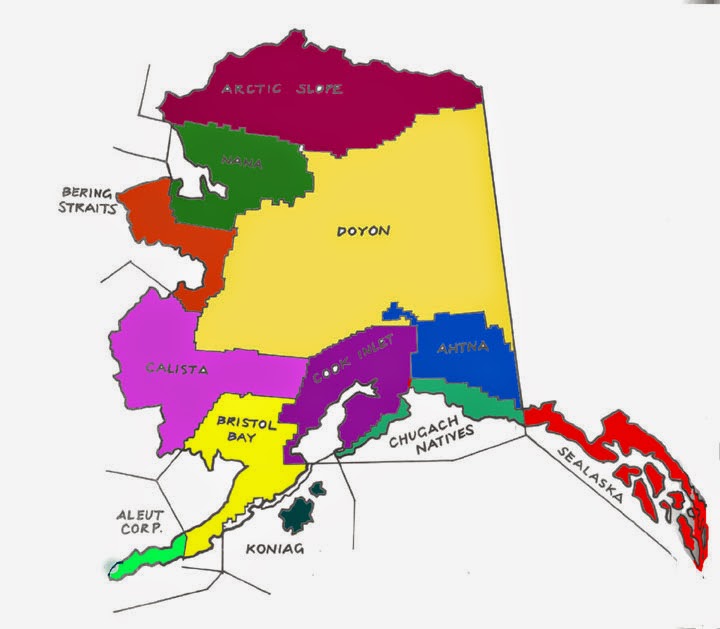
The Alaska Native Claims Settlement Act of 1971 was the largest land settlement made by the United States with an indigenous group. With the passage of the settlement the government formed 13 regional and hundreds of village Native-operated for-profit corporations in exchange for Native communities releasing their title claims to the Alaska region. Often maligned by the public, the settlement and their corporations, changed traditional cultural ways of living for Alaska Native communities in a variety of ways. This panel tracks the history of the settlement, with its origins in pre-statehood Alaska amid World War II Native alliances to the rise of the Alaska Federation of Natives through the Alaska Native Solidarity Movement. After giving consideration to the activist currents of political solidarity and their interests in maintaining traditional culture, that preceded the settlement, the panel examines how the introduction of IRA-based tribal governments in the 1990s complicated politics for the Native people, the corporations, and the State of Alaska. This is believed to be the first panel on the Alaska Native Claims Settlement Act by Alaska Native scholars at a national conference. 

Session 4      11:00 a.m. - 12:30 p.m.
Title:  A Tradition of Activism and the Alaska Native Claims Settlement Act
Room:  SUB Lobo A&B
Moderator:  Thomas Michael Swensen, Colorado State University

Holly Miowak Guise, History PhD Candidate, Yale University
Alaska Native Solidarity Movements During WWII
Maria Shaa Tlaa Williams, Associate Professor and Director, Alaska Native Studies, University of Alaska-Anchorage
Alaska Native Solidarity Movement and the Leadership Role of Nick Gray
Thomas Michael Swensen, Assistant Professor of Ethnic Studies,
Colorado State University
Impossible Sovereignties: The Alaska Federation of Natives, Native Corporations, and Tribal Governments in Alaska


December 28, 2014

Alaska Natives and the Land

In graduate school I was fortunate to study under the late Phil Frickey, Professor of Public Law at Bolt School of Law at the University of California Berkeley. My interests in Indian law drew from a research agenda involving the Alaska Native Claims Settlement Act of 1971 and its affects on indigenous relationships to land and water in Alaska. I took both Federal Indian Law I and II, as well as a semester of independent study, from him as he wrote the seminal work American Indian Law, Cases, and Commentary with his colleagues, legal scholars Anderson, Berger, and Krakoff. I found him generously patient with my general fumbling and innocent gaffs, letting me find my way through the nonlinear world of Native American law. Aside from legal study, one of the lessons he taught me was to try steering away from normative statements in my work.

One day after class he invited me up to his office to talk about a term paper. His office was a few floors up, in a converted dorm room, with a fantastic view of San Francisco bay. I sat down and he handed me the giant book Alaska Natives and the Land. I believe another student, a child of an Alaska state politician, gave the volume to Frickey and he in turn loaned it to me, indefinitely so it seems.

Cover of Alaska Natives and the Land
The humongous volume Alaska Natives and the Land composes a 565 page study of Alaska, its people, and natural resources by the Federal Field Committee on Development and Planning published 10 years after Alaska statehood in October 1968.  When open on my desk the work spreads out well over two and a half feet.


After the discovery of oil deposits in Prudoe Bay March 1968, the book served to educate congressional lawmakers about the region's indigenous people as Native leaders and activists labored with state and federal officials to come to terms with settling the issue of Native title. The book includes a marvelous 3 foot by 2 and a half foot foldable map detailing the Native communities within the state. The chart breaks down the regional areas with Native populations by size and by specifying whether the sites are predominately Native in nature (colored blue) or if they are non-indigenous sites with Native populations (red on the map).


Detail of Native community map
The book begins with an overview of Alaska Natives, moves to aspects of village life, to a chapter called Land and Ethnic Relations.


The chapter Land and Ethnic Relations discusses a regional analysis of Native identifications to indigenous territories. Since the book was a way to educate governmental leaders on Native land claims the chapter begins with a set of "pertinent" questions about Native land rights activism, like the query "Was, and is, there a definable dimension of Native ethnic territoriality?" Another intriguing question the chapter puts forth is " Did aboriginal "property rights" exist?" The narrative then argues that its findings, based from the assortment of questions, is that

"In their use of biological community for livelihood the Native people "occupied" the land in the sense of being on and over virtually all of it in the pursuit of their subsistence, but they did not "occupy" the land in any agrarian or legal sense as understood by Anglo-American Jurisprudence." 

Thus four years previous to the passage of the settlement there was an ideological argument against "Native title" even though indigenous actors themselves had been taking to the courts in regard to this matter for decades. In the exploration of the Kodiak region, the book extrapolates on the ways of Alutiiq people based on the Hubert Bancroft's History of Alaska(1886) and Ales Hrdlicka's Anthropology of Kodiak Island (1944), in the thesis that Kodiak Islanders, before the arrival of the Russians, held no reasonable form of government and simply foraged off the land and sea, "consuming anything that can be digested." These two misleading observations perhaps helped lawmakers conclude in the non-recognition of Native title during the time of settlement. 

This small read of the 565 page work lends little justice to the scope and importance Alaska Natives and the Land played in the passage of the land claims settlement and I would encourage anyone pursuing a course of research in Alaska Native geography, law, history, and culture to track down a copy. Also, Alaska Natives and the Land proves a great example of the many books written about areas of the world the US acquired through its various means. I have seen such volumes written on other national colonies such Hawaii, Puerto Rico, and the Philippines.

There are a few copies of Alaska Natives and the Land available on Amazon.


May 26, 2014

Alaska Native Representation and Knowledge at NAISA 2014: The Native American and Indigenous Studies Association Conference Austin, Texas


See you in Austin!
The Native American and Indigenous Studies Conference will be held in Austin this weekend and my Alaska grown colleagues Professor Jeane Breinig, Associate Professor of English, Associate Dean for the Humanities University of Alaska Anchorage, Professor Maria Shaa Tlaa Williams, Director of Alaska Native Studies, and I will be conducting the panel "Alaska Native Knowledge, Activism, and the Academy." In the conference program you can find the panel listed as "145. Alaska Native Knowledge, Activism, and the Academy [P62]: Meeting Room 416A." It is truly exciting to be able to take part in this wonderful conference with a cohort of brilliant and friendly Indigenous Alaskans. Please come say cama'i, you don't even need to bring Salmon. Below you will find the program information for the panel. Quyanna. 
 
Diagram of the Indigenous Self by Angayuqaq Oscar Kawagley, Ph.D.
Alaska Native Knowledge, Activism, and the Academy [P62]: Meeting Room 416A
2:00 PM – 3:45 PM Saturday May 31


In 2013 the first Alaska Native Studies conference was held at University of Alaska Anchorage, bringing over 350 participants from throughout the state and beyond to discuss issues central to Native Alaska. This conference marked the convergence of Alaskan Indigenous scholars, and their allies, creating a space of inquiry and intellectual self-determination focused distinctly within the Alaska region. The conference was a result of a landmark movement to start the Alaska Native Studies Council in 2012, which drew from a history of Indigenous knowledge activism for its foundation. This panel examines the obstacles and successes faced in the articulations of Indigenous knowledges within institutions of higher learning operated by the State of Alaska. The panel also traces the roots of Alaska Native intellectual, academic, and political activism, as well as the barriers faced in the creation of an Alaska Native Studies Council, Journal, and annual conference.

ORGANIZER

Thomas Michael Swensen, Assistant Professor of Ethnic Studies
Institutional affiliation: Colorado State University

CHAIR

Name: Jeane Breinig, Associate Professor of English, Associate Dean for the Humanities
Institutional affiliation: University of Alaska Anchorage

PAPER #1

Maria Shaa Tlaa Williams, Director of Alaska Native Studies
Institutional affiliation: University of Alaska, Anchorage
Title Paper 1: Formation of the Alaska Native Studies Council
Abstract Paper 1: In Spring of 2012 Alaska Native faculty initiated a new organization that was established to empower our place in academia. One of the outcomes of
our nascent group was the first ever Alaska Native Studies Conference that
was held in April 2013 and hosted by the University of Alaska Anchorage.
Academia remains a gatekeeper and placeholder in western knowledge
structures. As Indigenous knowledge finds its place within academia, we,
as Indigenous faculty have to create our own space and place. The
presentation will address how and why Alaska Native faculty established a
new organization and how we are 'dis-establishing' the hierarchy within
academia - making programs that place Indigenous worldview at the center.

PAPER #2
Thomas Michael Swensen
Title Paper 2: The Alaska Native Studies Movement
Abstract: Along with the emergence of the Alaska Native Studies Council, Alaska Native scholars, and their allies, are working within Native communities, universities, and aligned organizations, to promote the study of Alaska Native knowledge and culture as never before. Additionally, Alaska Native scholars are also being hired to tenure track positions throughout the contiguous “Lower-48” and Alaska Native graduate students are pursuing doctorates at record numbers. This critical mass draws from understudied Indigenous Alaskan histories and cultures of activism that have grown distinctly from activism elsewhere in the nation. How does this long-brewing movement contribute to the field of Native American and Indigenous Studies? This paper examines thematic linkages of sovereignty and self-determination Alaska Native studies asserts within the broader field as well as the possible interventions undertaken by these claims.

PAPER #3
Jeane Breinig
Institutional affiliation: University of Alaska Anchorage
Title Paper 3
Transforming the University: Alaska Natives and Higher Education
Abstract: In this panel presentation, I will discuss the process by which Alaska Natives are beginning to gain visibility and voice within the University of Alaska system, consisting of three major campuses in Anchorage, Fairbanks, and Juneau. This presentation includes historical background related to Alaska Natives presence in academia and the roadblocks faced when attempting to make a central place within the university system. Numerous programs and services, ostensibly created to serve Alaska Natives, have existed since the university was formed, yet only a few have made a significant difference with Alaska Native student success. This presentation proposes reasons and offers potential strategies for moving beyond the stasis.


April 20, 2014

The History of Reserves in Alaska


"Klukwan, Alaska on the Chilkat River. Extreme wide angle, showing village across water. Houses appear to be frame construction. Dugout canoe on beach in foreground." ASL-P87-2909

On April 21, 1913 President Woodrow Wilson created the Chilkat Native reserve at Klukwan. This was one of 150 reserves created by "Executive Order" before 1919. Executive Order (EO) is one of five methods the United States employed to recognize extra-constitutional indigenous spaces commonly called reservations. These EO reserves are referred to as "Reservations at Will." Besides these EO reservations there are four other forms of reservations, such as Treaty Reservations, Statutory Reservations,  Public Purpose Reservations, and reservations derived from the Indian Reorganization Act of 1934 (IRA). When the IRA was first brought into law and gave the ability of American Indians to structure into recognized governments under US law, it gave no provisions to include Alaska Natives.

However by 1936, with the help of Tlingit William Lewis Paul, the US extended the rights of the IRA to indigenous communities of the then Alaska Territory. After that time, the Tlingit community at Chilkat enrolled in the IRA and basically transferred the reservation into trust under the guidelines of the new law.

While many American Indian communities in the contiguous part of the nation have reservations from treaty negotiations this national practice of making treaties with Native was legislated out of existence in 1888, just before such negotiations could be made in Alaska. The backstory to the nation ending the treaty process with Native communities came about because the House of Representatives (without such power) saw this ability by the President and the Senate to create treaties as an unfair advantage. Thus, when the House added a rider to end the making of treaties with Natives to a bill, the rest is history.

A general view of Metlakatla taken at 9:30 p.m. , 1896.
Buildings and dwellings, with mountains in background
ASL-P326-10
The history of reservations in Alaska began with the Congressional manufacturing the Metlakatla statutory reserve in 1891. The reservation came under scrutiny in 1916 when the Alaska Pacific Fisheries corporation started placing a fish trap just off shore of the island. However, as the trap neared completion President Wilson declared the waters near the island as additional reservation property. The Department of Justice filed suit against the cannery, leading to a Supreme Court case where the court affirmed the reservation in 1916.

At Eklutna Vocational School, ca. 1940. "Students at Eklutna Vocational School, Eklutna, Alaska, with telegraph apparatus. ca. 1940." AMRC-b00-10-11.
The United States also made a second type of "Reservation at Will," this kind known as Public Purpose Reservations that only served very discrete functions. Unlike a statutory or Executive Order Reservations, Public Purpose reserves in Alaska mostly acted as spaces for the vocational training of Native workers. For example, the government made reserves for the sole of purpose of teaching indigenous people how to herd reindeer. Above is a picture taken at the Eklutna, a public purpose reservation that had a technical employment training school.

"School, quarters, and part of homes, Venetie, Alaska, 3/1939."
ASL-P306-0760
Since the late nineteenth century the US has created four types of reservations in Alaska, each distinct from the other. The addenda to the 1934 Indian Reorganization Act did allow the Department of the Interior to take land to be held in trust for Native governments. Yet the passage of the Alaska Native Claims Settlement Act in 1971 ended all reservational communities, even if such communities chose to forego ANCSA enrollment, as did the community of Venetie. ANCSA allotted the land to the village fee simple. While all the reservations may have disappeared, the first Metlakatla still exists to this day.

Metlakatla in the 1890s. For more information about this community click here: http://www.metlakatla.com

February 25, 2014

U.S. Law and Indian Country in Alaska


Today marks the 16th Anniversary of Alaska v. Native Village of Venetie Tribal Government (1998), a Supreme Court case that ended with the denouncement of Indian Country in the state of Alaska (522 U.S. 520). In 1986 the Venetie tribal council imposed tax on contractors doing business on their land in partnership with the state of Alaska. The Supreme Court granted writ of judicial review on appeal from the United States Court of Appeals for the Ninth Circuit. The Ninth circuit had ruled in the tribe's favor, saying the tribe occupied the legal jurisdiction of "Indian Country" and was within their rights to collect taxes from said contractor. Through unanimous decision the court asserted that the tribe was without the power to tax the contractors because the parcels of land were not located on a reservation. As I understand it, the tribe owned the land fee-simple without a trust-status (based on their opting out of the Alaska Native Claims Settlement Act) whereby the government would recognize a tribe's right to tax such activities. The ruling in the case was that "Indian Country" failed to exist in Alaska, since (as they saw it) the Alaska Native Claims Settlement Act made such claims impossible.

The term “Indian country,” as defined by federal statute 18 U.S.C. § 1151:

(a) all land within the limits of any Indian reservation under the jurisdiction of the United States Government, notwithstanding the issuance of any patent, and, including rights-of-way running through the reservation,

(b) all dependent Indian communities within the borders of the United States whether within the original or subsequently acquired territory thereof, and whether within or without the limits of a state, and

(c) all Indian allotments, the Indian titles to which have not been extinguished, including rights-of-way running through the same

However, the court saw that due to the Alaska Native Claims Settlement Act (43 U.S.C. 1601 et sec.), 
claims to "Indian Country" for Alaska Natives was non-existent.

Majority opinion delivered by Judge Clarence Thomas:

To this end, ANCSA [the Alaska Native Claims Settlement Act] revoked “the various reserves set aside … for Native use” by legislative or executive action, except for the Annette Island Reserve inhabited by the Metlakatla Indians, and completely extinguished all aboriginal claims to Alaska land. §§1603, 1618(a). In return, Congress authorized the transfer of $962.5 million in federal funds and approximately 44 million acres of Alaska land to state-chartered private business corporations that were to be formed pursuant to the statute; all of the shareholders of these corporations were required to be Alaska Natives. §§1605, 1607, 1613. The ANCSA corporations received title to the transferred land in fee simple, and no federal restrictions applied to subsequent land transfers by them.


August 13, 2013

Siberian Yupik Historical Narrative and Inupiat Science Fiction


Brand new copy

Native Alaska possesses a wide arrangement of talented artists and writers, including carvers, poets, novelists, filmmakers, performance artists, painters, dancers, and musicians. The Indigenous people from throughout the state have formed a strong cultural archive of work from which at times I have drawn from in the production of my scholarship. This all started for me upon entering graduate school at the University of Oregon in 2003. Amid my first week at Oregon I met with an Alaska Native professor for coffee at a place on Patterson and 13th, across from the Green Duck. At that meeting she gave me a copy of Alaska Native Writers, Storytellers & Orators: The Expanded Edition (2001) edited by Ronald Spatz, Jeane Breing, Patricia H. Partnow(based on an original edition by Nora Marks and Richard Duenhauer, and Gary Holthaus). The collection presents Alaska Native oral histories, in print form, poetry, prose, and even art work. I have used it since that time as an invaluable resource. Over the years my copy has grown dog-eared, bent, as well as scribbled upon and underlined throughout it's over 370 pages. Fortunately at the 2013 inaugural Alaska Native Studies conference at University of Alaska, Anchorage, last spring, the conference organizers provided attendees with fresh copies!

It was great to see the book going into more hands because the collection introduced me to many exciting Alaska Native writers but in this post I want to funnel it down to the work of Susie Silook and Fred Bigjim. Susie Silook is a visual artist and writer whose incredible gifts of storytelling always seem to draw from Siberian Yupik heritage, modern histories of colonialism, and more than slightly touch on the realities of the present. Though she succeeds in telling stories through bone and ivory as a carver, the way her writing connects traditional culture with the contemporary Native experiences proves astounding to me. Three written works appear in Alaska Native Writers, Storytellers & Orators, the short story, "Anti Depression Ulimaaq," and the poems, "Uncle Good Intentions," and "Adventure in Chinatown 1958." Each fearlessly builds narratives that concern histories formed at trying times and these pieces include themes such as racism, family relationships, and the uncanny federal policies directed at Native people throughout the 20th century. One for example, involves the history of eugenic policies enacted by the United States upon the people of St. Lawrence Island. In 2001 she was involved in the group show "Ceremony of Healing: Expression Concerning Violence Against Alaska Native Women." Silook joined other Alaska Native lady artists like Diane Benson (also featured in the book), Helen McNeil, Susie Bevins, and Sonya Kelliher-Combs to confront the ongoing harm being done to Native women. Perhaps Susie Silook will allow me to interview her for the blog? You can read more about her and the "Ceremony of Healing" show at:
http://www.ewebtribe.com/NACulture/articles/ADN-WaysofHealing.htm
http://www.ewebtribe.com/NACulture/articles/ADN-Artofoutrage.htm


Fred Seagayuk Bigjim is an Inupiat writer included in the Alaska Native Writers, Storytellers & Orators collection I want to mention. The two pieces included in the collection are, "Ballet in Bethel," and "Gaslight." Yes, the "Gaslight" is a lonely poem concerning the old Anchorage bar on 4th avenue. "Ballet in Bethel" confronts the imposition of Western cultural art practices among Alaska Natives. Bigjim has published broadly across genres but right now I am reading a 1999 science fiction novel by him called Plants. 


 Signed copy! 

This book concerns a journalist investigating a downed satellite in South Dakota where upon he befriends American Indian medicine men and their "plants" that could disrupt the free flow of telecommunications.  Aliens, as the back cover details, also have "plants" on earth which monitor all developments. Without giving too much away, I would say that anyone who has read Almanac of the Dead, by Leslie Marmon Silko, and remembers the Inupiat elder who can control radar systems through a television at a rest home, would very much enjoy this novel. Right now, I have an article submitted to American Indian Quarterly which reads the historical aspects of his work Letters to Howard: An Interpretation of the Alaska Native Land Claims. Anyone interested in Alaska Native history and literature would find his work an enthralling read.


July 24, 2013

The Distance Between November 6, 1971 and December 18, 1971

On November 6, 1971 the United States military detonated the 5-megaton Cannikin nuclear device deep in the earth at Amchitka Island, Alaska. They were testing the effectiveness of the weapon's design as well as new tools made for measuring seismic shifts. This explosion stands as the largest in national history and many feared it would create earthquakes throughout the region. The apprehension was due to Amchitka, or Amchixtax̂, sitting on the Aleutian chain, along the tectonic trench that allows a warm current to flow from the waters proximal to Japan up to Kodiak beaches. The island, previously inhabited for thousands of years, lies approximately 1300 miles southwest of Anchorage Alaska, bordering on the United States side of the chain. Cannikin was the final of three tests on Amchitka and its detonation coincided with the passage of the Alaska Native Claims Settlement Act December 18, 1971 (43 U.S.C. 1601). The settlement proved the most considerable agreement the nation had contracted with an Indigenous group. Through the nullification of Alaska Native claims to land and water rights the public law established village and regional corporations to manage lands (parcels not transferred to state and federal holdings through the agreement) in fee-simple status. The clip below presents the Cannikin detonation on Amchitka. Watch the ground rumble and consider the shock the sea mammals felt as it relayed through the water. 


The distance of weeks between Cannikin and the passage of the Alaska Native Claims Settlement Act proves haunting to say the least. The explosion embodied the peak of the nation's technological progress-narrative. In a blast 400 times larger than the bomb dropped on Hiroshima, "little boy," it was reportedly without injury to humans. Not accounting for the other damages to the island nor the living creatures on or around it, there are reports that Cannikin claimed the lives of thousands of sea otters, a mammal important for the subsistence traditions of "Aleut" cultures. Relationally, the Alaska Native Claims Settlement Act opened the Alaska region for oil companies and other businesses interested in resource extraction and exploitation. That the government detonated the bomb previous to the passage of the settlement reverberates an uncanny symbol for the transfer of Native occupancy rights to the nation. What must have Native leaders thought when they witnessed the explosion on television or read about in newspapers? Did it lend a coercive element to the settlement process? Were they even informed of the development? The parallels with Cannikin and the Alaska Native Claims settlement to other events in the nation's history are numerous. To list a few, analogies to Hiroshima, Wounded Knee, and the Bear River Massacre abound.

The archive reveals this personal photograph below of Nick Neuzorof (left), Inokenty Golodov (right). They are two Unangax̂, Unangan, men working on the island in 1961. During World War II Amchitka was at the heart of the pacific theater of battle between the United States and Japan. For a host of reasons brought on through national authority by the early 1940s Native folks no longer resided there, nor used the island as a place for subsistence practices. After the war the island hosted ports, landing strips, and communications systems left over from the war. In the birth of the Cold W
ar the government began considering the island for nuclear tests in the 1950s. By the early 1960s plans were underway for the first test in 1965. Mr. Neuzorof and Mr. Golodov were apparently employed by one these enterprises on the island. Beneath that photograph is another taken over a decade later of Bureau of Indian Affairs official Bert Bauer, paying Billy B. Johnson, in the role of representing the 13th corporation, over 7 million dollars for the extinguishment of land claims with the nation. How may have the Cannikin bomb influenced the settlement process?

Nick & Innokenty, Amchitka Island, Nick Neuzorof (left), Inokenty Golodov (right), Aleut.
Steve McCutcheon Collection
Identifier AMRC-B1990-014-5-AKNative-27-50 circa. 1961
"Handing over the first money the 13th received."
Collection Billy Blackjack Johnson Papers, 1923-1997. UAA-HMC-0384
Identifier UAA-hmc-0384-s3-f10-3
(Some point in the 1970s) 
While the research for this blog dilates Alaska Native studies the obvious connection point between Cannikin and the Alaska Native Claims Settlement in the archive lies with the late senator from Alaska, Ted Stevens. Stevens invested his long life with decades of service to Alaska and the claims settlement was a paramount contribution he helped engineer into regional history. Below is a one-minute clip with Stevens discussing the Alaska Native Claims Settlement Act in regard to a debate in 1992 about Native subsistence practices.


Here is the Senator, one of many photographs, touring the facilities and grounds on Amchitka in 1971, before the nuclear detonation and the Alaska Native Claims Settlement fashioned into law.

Sen. Stevens, Amchitka, Atomic blast project.
Steve McCutcheon, McCutcheon Collection, Anchorage Museum, B1990.14.5.Pol.4.237 
Another photograph places the senator with two unnamed Unangax̂, Unangan, workers at Cannikin also in 1971. The younger man is the foreground wears a nylon jacket while the Senator adorns a fur coat. The fondness of nylon jackets by Native people of that generation always makes me smile, even in a foreboding image as this. I'd imagine they're hard to find these days.
"Sen. Ted Stevens w[ith] Aleuts of St. Paul, atomic blast project."
Identifier: AMRC-B1990-014-5-Pol-04-231
Steve McCutcheon, McCutcheon Collection, Anchorage Museum, B1990.14.5.Pol.4.231
The detonation and the settlement present an interesting riddle. Growing into adulthood I learned more than just the basics about Alaska Native Claims settlement Act through lived experience but only through research have I scratched upon the profundity of the relationship the settlement possesses with the nuclear tests.