Showing posts with label History. Show all posts

July 7, 2015

Self-reinvention in the Birth of the Last Frontier

On June 25, 1897 the steamer the Alice carried a first load of gold through St. Michael's Trading post in Yupik territory on the western coast of the Alaska. Originally the Russian American company founded St. Michael Redoubt in 1833 and by 1897 the town of St. Michael became a major hub in the burgeoning Yukon-Alaska Gold Rush. The map below illustrates the Yukon trade routes the mineral would travel with St. Michael there on the shores of western Alaska Territory.


Klondike travel routes
Between 1886 and 1899 approximately 100,000 people entered (invaded?) the Alaska-Yukon area with aspirations of securing hefty tins of gold. This urgent haste started after, in August 1896, a group of Tagist family members, Shaaw Tláa, K̲áa Goox̱, and Keish, and Shaaw Tláa's non-Native husband George Carmack located gold in Rabbit Creek (afterwords known as Banaza Creek), around the relatively new (and contested) border between Alaska and Canada. The family decided to allow Carmack to announce the discovery to the trading post because the authorities would most likely have denied such claims made by Native people, leaving the claim open to others.


When near-do-wells flooded the north armed with pick axes and gold pans they transformed the shape and governance structures of Natives villages and towns. For example within a year from three prospectors finding gold in the village of Siqnazuaq in 1897, which previously held less than a 1,000 residents, the population swelled to 10,000. Upon the coming of this immense amount of people, Siqnazuaq's name was changed to Nome, Alaska. It's estimated that by the early twentieth century the town's population reached 28, 000. Currently, the population sits under 4,000.


The Alaska Territory's boom economy reopened an American frontier once proclaimed closed by historian Fredrick Jackson Turner in 1893 with his work  The Frontier in American History. In the nineteenth century there was an idea that the continent was an empty space allowing non-Natives to travel westward, securing land and sequestering and killing Native people, until the movement ended on the Pacific side of the contiguous part of the nation, what would be known as the "Lower-48." As the United States pushed westward that shifting border allowed those, within the context of U.S. sponsorship, to reinvent themselves. For Turner,  the end of the frontier meant the foreclosure to a distinct way of life, an end for the ability of the nation's population to reinvent and adapt themselves to a new land. Fortunately for the nation, the gold rush in the Alaska Territory created a "Last Frontier" bringing with it a sense of renewal to the nation's imagination. Factory workers in the industrial economy could rest assured that there were rugged independent people at the edge of the nation living lives that their own social and financial situations disallowed them (this is of course the time when Inuit art came to serve a similar purpose).

Felice Pedroni aka Felix Pedro
One such story of reinvention in the Last Frontier was that of prospector Felice Pedroni who uncovered gold amidst the shallows of Cleary Creek, now Pedro Creek, in the Fairbanks region of central Alaska allegedly on July 22, 1902. Born in Trignano di Fanano, Pedroni sailed to New York in 1881 at 23 years of age when he reinvented himself as Felix Pedro, donning a Hispanic name change. Working his way through the country he moved to the Yukon in 1895, with dreams of gold. His search went on for years as he worked claims on either side of the border. Upon a discovery near the Tanana Hills, he famously exclaimed, "There's gold in them there hills!"

Journalist and historian Dermot Cole discusses the shadow of scandal and drama that surrounded Pedroni's life in this exciting article published through the Alaskan Newsminer.com. Pedroni's claim to the mining site proves complicated by a partner Alexander L. Hanot, whom Pedroni knew from his days working in Washington state. Pedro claimed that the only reason Hanot became a split partner with him was that latter owed him 75,000 dollars and that signing him into the claim protected Pedroni's assets due to an alleged maternity case. Hanot denied such allegations that he owed money or that even his share of the claim was fake in any sense. Pedro asserted that when he made the deal with Hanot he was not of a healthy mind. From 1903 to 1909 various people testified to Pedro's deteriorating mental health, notes Cole. Yet, other's testified to the contrary! In divorce papers, Cole writes, Pedro's wife accused her husband of fraud in the Hanot situation.

View of a stone monument with brass plaque dedicated to Felix Pedro located at mile 16.5 of the Steese Highway at the location where Felix Pedro is believed to have discovered gold in 1902. UAA-hmc-0620-series1-f5-16
8 years after his claim, Pedro passed away at the age of 52. Reportedly losing his life to a heart attack, many thought he was a victim of murder. He body was buried in California and laid there until exhumed in 1972 to ship to his hometown in Italy. Upon the transfer, his body was examined and authorities determined his death was the result of ingesting poison. Many suspect his wife Mary Doran took his life. The notion of the frontier in the national imagery served for countless people such as Felice Pedroni shed their old lives as they domesticated an imagined frontier, refusing to acknowledge Indigenous lands, culture, and authority. One need not be Edward Said to see that the imaginative geography of imperial frontiers, which allow people to put forth, new names, or invented personas, are always home to other communities these actors help dispossess.


Source:
Dermot Cole's article "Accusations of scandal, legal battle followed Felix Pedro to the grave"
http://www.newsminer.com/news/dermot_cole/accusations-of-scandal-legal-battle-followed-felix-pedro-to-the/article_7635918a-f112-11e2-a15e-001a4bcf6878.html

June 21, 2015

Attu Boy: Unangax̂ Prisoners of the Japanese during World War II


Japanese troops raise the Imperial battle flag on Kiska Island in the Aleutians on June 6, 1942
Coordinated with the Battle of Midway as part the Pacific Theater of World War II, around the island of Amaxnax̂, at Dutch Harbor, the Japanese Navy attacked the American territory of the Aleutian Islands. On June 3rd and 4th, 1942, six months after the bombing of Pearl Harbor, they took the US Navy Weather Station on Qisxa island, Kiska in English, that held 12 Navy personnel. Two American soldiers lost their lives as the Japanese rounded up the island's residents. One man fled their capture, but turned himself in after about a month and a half of hiding on the island. One of the main reasons for the occupation was that is doing so they could control that shipping route corridor of the North Pacific. I have an Sugpiaq cousin who worked down in Dutch Harbor during the war when he was 16 years old, cleaning the pilot's sleeping quarters.

Picture of the June 3rd Attack on Dutch Harbor.
"The village. View of Attu." Photograph taken during the 1937 Smithsonian Institution's Archaeological Expedition to the Aleutian Islands. uaa-hmc-0690-s1-1937-69a 
On June 7th, the 301st Independent Infantry Battalion of the Japanese Northern Army invaded the Aleutian island of Atan, or Attu in English. The axis fighters made 44 villagers, two of them non-Native, prisoners of war. The villagers remained captive for months before they removed them from the island and interned them at a prisoner of war camp at Otaru, Hokkaido. Half of the islanders would never return from the camp.

 "Aleut (Unangan) relocation to Southeast Alaska: Kasaan, Killisnoo, and Ward Lake Refugee Camps, 1942." Photographer's notes: Vaccinations, Aleut Refugee children. Three girls, F. Prokopeuff, Oleana Snigaroff and Anfesia Gardner, laughing and holding their shoulder. ASL-P306-1065
On June 12, 1942 the United States began forcibly removing 880 Unangax̂ people, and their associated family members, from their villages in the Aleutians. After making them help raze their homes, the government boarded them on ships. Once in the water, government transported Non-Native villagers to the contiguous part of the nation and the Unangax̂ people taken to dilapidated facilities along the Alaskan Panhandle. Over the following two years, due to unsanitary conditions, one in ten islanders would lose their lives in residence at the camps. Important to note that just 30 miles away from one camp, the United States kept German prisoners of war in more humane conditions then they did their own citizens.


This month marks 73 years since the United States and Japan began the transnational project to intern the Unangax^. These islanders suffered great losses even though they were not at war with either nation. United States and Japanese efforts to fight one another worked together in dislocating a third group of people (note: Unangax̂ were and are US citizens). Hundreds of islanders would never return to their homes again, nor would they reunite with their Non-Native loved ones at the time of the war's end. Nick Golodoff was a child on Attu when the Japanese invaded and occupied the island. He returned to live his life away from the village after surviving the prisoner of war camp in Otaru. The reason why he didn't go back was because with so few remaining islanders the government choose to leave the village uninhabited, distributing them to other villages. Golodoff wrote a beautiful memoir  of his war time experiences in the book Attu Boy: A Young Alaskan's WWII Memoir. Leaving behind loving family, Golodoff passed away in 2013. Below is a moving interview he did with then KUBC reporter Stephanie Joyce in 2012.


June 1, 2015

The Politics of Alaska Native Arts and Culture Panel NAISA 2015


The Native American and Indigenous Studies Association (NAISA) 2015 Annual Meeting takes place from June 4-6 in Washington, DC, brought to life hosted by the National Congress of American Indians and other regional institutions. This year there are panels dedicated to Alaska Native Studies with other Alaska Native studies scholars in mixed panels. As 40 percent of the nation's tribes, I'm thrilled to see at all this work at the conference this year. Alaska specific things bolded, below. There maybe more, so we'll see.


2:00 PM – 3:45 PM Friday June 5 

063. Politics of Alaska Native Arts and Culture
Panel
4:00 to 5:45 pm
Hyatt Regency: Redwood
Chair:
Thomas Michael Swensen, Colorado State University Participants:
“Propatriation: Tlingit Arts in the NAGPRA Era” Emily Moore, Colorado State University
“Arts and Oral Traditions: Engaging “Storywork” in Higher Education” Beth Leonard, University of

Alaska Fairbanks
“Uncovering a History of Art and Violence through Susie Silook’s The Anti-Depression Uliimaaq.”
Thomas Michael Swensen, Colorado State University 

Thursday June 4 


111. Indigenous Natural law and Natural Resource Governance: Theoretical and Empirical Perspectives
Panel
2:00 to 3:45 pm
Hyatt Regency: Concord
Chair:

TBD
Participants:
Establishing Indigenous Natural Law through Indigenous Ontology & Epistemology
Molly Sparhawk, University of Alaska Fairbanks
Re-examining Treaty through Nêhiyaw pimâcihowin (Plains Cree Way of Life): Paulina Reghan
Johnson, Western University
Uncovering the Doctrine of Mana Moana to Better Articulate Maori rights to Water Victoria Skelton,
University of Auckland
Changing corporate culture: Indigenous influence on extractive companies via negotiated agreements
Julia Keenan, The University of Queensland 

Saturday June 6


10:00 AM – 11:45 AM Saturday June 6


158. Ecological Knowledge and Imagination
Paper Session
10:00 to 11:45 am
Hyatt Regency: Yellowstone
Chair:
Nancy Van Styvendale, University of Saskatchewan Participants:
"I’m Gonna Buy Me an Island": Road Development and Environmental Criticism in Tomson Highway’s The Rez Sisters Cameron Paul, Univerity of British Columbia
Decolonizing Dispossession: Rethinking Adivasi Land Relations in a Decolonial-Feminist Frame Padini Nirmal, Clark University
Indigenous Knowledge, Oral History and Place: Collaborative Research in a Northern Northwest community Judith D Ramos, University of Alaska, Fairbanks
Views from the End of the World: Conservation Ethics in Leslie Marmon Silko’s Almanac of the Dead and Cormac McCarthy’s The Road Virginia Kennedy, PhD, Otsego Land Trust 


2:00 PM – 3:45 AM Saturday June 6 

162. Modernizing the Trust for Self-Determination: A Policy Forum on Indigenous Education in the U.S.
Roundtable

2:00 to 3:45 pm
Hyatt Regency: Columbia C 
Chair:
TBD
Presenters:Malia Villegas, National Congress of American IndiansWilliam Mendoza, White House Initiative on American Indian and Alaska Native Education Carrie Billy, American Indian Higher Education ConsortiumBrian McKinley Jones Brayboy, Arizona State University 


2:00-3:45 Saturday June 6

164. Resisting Boundaries
Paper Session
2:00 to 3:45 pm
Hyatt Regency: Congressional D
Chair:
Dina Gilio-Whitaker, Center for World Indigenous Studies Participants:
Beading and Walking Sovereignty: Dene Resurgence against Canadian Sovereignty Kelsey Wrightson, University of British Columbia
Indigenous Nations Challenging Transnationalism: Anishinaabe Narratives Crossing and Creating Borders in Northern Minnesota Nicholas Cragoe, University of Illinois at Urbana-Champaign
Indigenous (Im)Mobility and the Borderlands of North America Levin Arnsperger, Emory University Between Empires and Frontiers: Alaska Native Sovereignty, Statehood, and U.S. Settler Imperialism
Jessica Leslie Arnett, University of Minnesota 


4:00 PM – 5:45 Saturday June 6
176. Diasporic Times: Complicating Space-Based Approaches to Native American and Indigenous Diasporas
Panel
4:00 to 5:45 pm
Hyatt Regency: Bryce
Chair:
TBD
Participants:
Will Rogers’ Occupations: Temporal Diaspora through Performance
Bethany Hughes, Northwestern
University
Remembering Aleut Internment in World War II Alaska Holly Guise, Yale University
Eradication Nation: Disrupting the Time of Settler-Colonialism in Simon Ortiz’s From Sand Creek and Sherwin Bitsui’s Flood Song Christopher Pexa, Cornell University
“A Meeting Place for All”: Cultural Production and Embodied Resistance at Haskell’s 1926
Homecoming and Powwow Beth Eby, University of Illinois at Urbana-Champaign 
Comment:
Jeane Breinig, University of Alaska, Anchorage 


April 28, 2015

Bali Balita!: the Kadiak Times, Filipinos, and the Aleutian Homes

Filipino man holding sea eel
ASL-P97-2-278 


In the latter half of the 20th century the State of Alaska hosted numerous regional periodicals, most notably the Tundra Times, managed by artist Howard Rock. There was also the Kadiak Times, a community-based newspaper, serving the Kodiak, Alaska Archipelago from 1976 into the early 1980s. Over the course of its life it was published and co-owned by numerous people including Alaska political leader Alan Austerman. 


The October 24, 1986 issue, pictured above, belongs to my personal archive because it lends significant detail about the history of the Woody Island Ice Company. The United States included approximately 200,000 dollars for the ice company contracts in its of payment 7,200,000 dollars to the Russia from the ownership of the region. The Woody Island Ice Company served the contiguous part of the nation for decades. More than being a purveyor of history, the Kadiak Times was also a place for local communities to reach out to its members.


Above is an installment of the "Pista Pilipiniana Bali Balita," section from the Kadiak Times written by Manby Narra,  on behalf of the Fil-Am Association of Kodiak. The article is written twice once in Tagalog and another in English set beside one another. In the column Narra congratulates the parents of a new born as well as mentioning that celebrities, pop singer and actress Pilita Corrales, actress Jackie Lou Blanco, and Corrales' partner Amado Del Paraguay, would be visiting Kodiak. In closing Narra reminds readers to pay their association dues. The brief "Pista Pilipiniana Bali -- Balita" provides informative insight into the life of the Kodiak Filipino community in the 1980s.

A 1953 portrait of a two women, Tlingit and Filipina, at the Seward Sanitorium, a vocational training center. "Esmailka" under the female on the left, and "Auelino" under the female on the right. uaa-hmc-1148-1-53 
Many people unfamilar with Alaska may not know that most southern coastal towns, and villages, hold sizable if not predominant Filipino populations. The late Alaskan political activist and historian Thelma Garcia Buchholdt, who served in the Alaska House of Representatives from 1974-1982, wrote the compelling Filipinos in Alaska 1788-1958, documenting Filipino participation in the development of Alaska. In the sixteenth century, Filipino sailors accompanied Spanish galleons throughout the Pacific, including stops along the Alaska coast. Buchholdt marks that a "Manila Man" was on board a ship that docked in the newly Christened "Cook Inlet" in 1788. These "Manila Men" took part in the development of nineteenth century the whaling in Alaskan waters. In the previous blog post Three Thousand Filipinos and the William Lewis Paul Papers I briefly discussed that Filipinos, who became known as Alaskeros, were active in the burgeoning early twentieth-century fishing industrial complex in Alaska. These communities also worked in Alaska mines, as well.

During the late nineteenth century, capital investments in new canning techniques changed the rapidity and safety in the process of fish canning at an industrial level. This advancement allowed many large-scale companies to set up shop in southern Alaska. In the growth of the industry hundreds if not thousands of Alaskeros worked in the cannery slime-lines and packing houses by 1911. At the University of Washington Special Collections are the Cannery Workers and Farm Laborers Union, Local 7 archive that document some of the work the Alaskeros performed in canneries. Founded in 1933 the union represented mainly Filipino workers throughout the Pacific American coast, many of them in Alaska canneries. I've spent a couple of days sifting through the extensive union records and find them quite a fascinating collection.


I grew up in the Kodiak neighborhood of the Aleutian Homes, which since I have been alive has been an area where many Filipinos live. Above is a short documentary by James Guilas about the history of the Aleutian Homes and how and when Filipinos moved there. Guilas talks about the size of the Filipino population in Kodiak as being 30 percent when he put this together, but the last I've read its between 35 and 41 percent, since he made the film.


April 13, 2015

"For the Progress of Man:" Tikigaq and Nuclear Landscaping

From "Project Chariot Marine Mammal Study, Cape Thompson, 1960-61." ASL-PCA-561

"If your mountain is not in the right place, just drop us a card."
Edward Teller, University of Alaska Commencement Address, 1959

In 1958 The United States Atomic Energy Commission proposed "Project Plowshare" to detonate a 2.4 megaton series of nuclear explosions in the building of a harbor off Alaska's northwestern coast. George Washington University Professor Al Teich describes the project as part of a larger trend among scientists called "nuclear landscaping." For after the advent of nuclear weaponry, scientists grew interested in the possible ways these devices could reshape expanses of land and alter seascapes. The Alaska mission was planned to take place at Cape Thompson, about 32 miles from Tikigaq, or The Village of Point Hope. A 1961 editorial in the Anchorage Times entitled "Alaska Test Needed For Progress of Man," argued for the venture on the grounds that building the harbor in that region would create viable economic opportunities for the new state, in the way of a large port. "Such development would," the op-ed by owner Robert Atwood asserted, "stimulate opportunities for employment and better living conditions in the area now on the fringe of civilization." The Inupiat communities living in the area of the area of the Project Chariot however felt it would hold terrible impacts on their life ways and  the animals of their homeland.
Original scheme for Project Chariot.
In the 1989 The Bulletin of Atomic Scientists article, "Project Chariot: How Alaska Escaped Nuclear Excavation," writer Dan O'Neill documented how the Chariot proposal was to be the first in a set of works in the Plowshares program that would rebuild the world through nuclear destruction. Brainchild of Edward Teller, lead Scientist at the Livermore Labs, the plowshares program would, under his guidance, (quoted through O'Neill) "engage in the great art of geographic engineering, to reshape the earth at your pleasure." Plowshares was part of a even more nationwide postwar movement to re-engineer landforms through massive endeavors, such as was the Glen Canyon Dam in southern Utah.

A 1958 picture of Edward Teller as Director of Lawrence Livermore National Laboratory
With great concern, the region's people, along with a concert of citizens outside the area, questioned how the explosions and the following radiation would harm the environment and their communities. Looking at how such devices brought terrible conditions to Nagasaki and the Bikini Islanders, the Inupiat didn't believe the promises of safely the government gave them. According to O'Neill, village representative David Frankson argued strongly against the idea, as did all regional Inupiat and Athabaskan communities.
David Frankson, in glasses, pictured with a group of Native representatives meeting with Gov. Egan.
The threats of Plowshare program, along with burgeoning governmental policies set to restrict Native subsistence life ways, made the Association of American Indian Affairs host the Point Barrow Conference on Native Rights in November, 1961. The conference resulted in the formation of the regional Inupiat Paitot organization, which included Frankson and artist Howard Rock. "Our Inupiat Paitot," they wrote in a statement, "is our land around the whole arctic world where Inupiat live, our right to be great hunters and brave independent people...our right to the minerals that belong to us in the land we claim." For the first time Inupiat people across Alaska formed an alliance as to express specific concerns for their rights as indigenous people. In their statement they wrote of Project Chariot, demanding a halt to the program, saying "The result of this explosion will be very dangerous to native health because of the effect of  radiation on animals the people have depended on for food." The Paitot articulated the larger cycle of life at stake in Project Chariot, by connecting their health to the health of the environment. "We deny the right of the Bureau of Land Management," their statement read, "to dispose of land claimed by a native village, and urge the Interior Department to revoke the permit before the experiment goes any further." The Inupiat Paitot also expressed that such nuclear tests held transnational consequences when communicating, "We, the Inupiat, strongly protest," any such activity on their lands,  "and request the President of the United States that the experiments of the Russians on their nuclear explosions be discontinued," as well.

In the summer of 1962, The government sidelined Project Chariot due to unforeseen "flaws" in its design. Yet the threat levied against the Inupiat by the proposal led to a political organization, which in a year and a half, began working with the Alaska Native Brotherhood and the Dena Nena Henash forming a large scale movement to secure Native rights to land and heritage in Alaska. These three political groups stood as foundational to the Native rights movement of the 1960s that would work toward the Alaska Native Claims Settlement Act of 1971.

Inupiat filmmaker Rachel Naninaaq Edwardson made the incredible 2012 documentary Project Chariot, where she examines the history of the project and the fight against it in much detail.  The trailer below on Edwardson's Vimeo site.


Works Consulted/Cited

Al Teich's Tibits http://www.alteich.com/tidbits/t050602.htm
Other government documents.

January 27, 2015

Debt and Alaska Native Cooperatives

Alaska Natives possessed a variety of formal organizations before and during the implementation of IRA-based (and styled) tribal governments and ANCSA Native-operated corporations. One of these formations, cooperatives, formed in villages as instruments to bring Natives into an emerging regional economy set-up by new comers. The cooperatives came as the US business interests increasing developed enterprises that extracted natural resources such as timber and sea life from the region. In doing so, the businesses quite often blocked Native access to traditional resource sites, altering the very life ways of these Native communities. One of the consequences of being forced from traditional lifeways was that Indigenous individuals funneled into the asymmetric employment conditions of cannery work. Often governing structures possessed legally consigned financial instruments for bringing Native people into the US economy, and Native people with few options had to participate.

Native houses at the Naknek Packing Co. Cannery.UAA-hmc-0186-volume4-3795
Even before the changes in Indian Reorganization Act to include Alaska Natives, the government enrolled Native individuals into chartered stock companies. Drawing from previous posts on this blog, many Natives once indoctrinated into the reindeer herding business then faced compulsory ownership in the reindeer industry. As active investors in industry, the worked to turn a fair profit on their labor.

Two men, Frank Seppilu and Irving Ifkohluk, sit at the entrance of a tent, counting reindeer. 
Collection: O. C. and Ruth Connelly, 1938-1941.
UAA-hmc-0562-53 c
Also in 1936 under provision 17 of the IRA, Native communities could organized as cooperative associations. Legal scholars David Case and David Voluck assert that these cooperatives brought together Native individuals by way of their "common occupation," rather than their "strict geographic residence." That is, the cooperatives activated in the spaces of labor activities brought together Natives through their involvement in the new territorial work force for what was surely promised to be measurable profits.


Above is a newspaper article I found while conducting archival work for my current book project. From 1954, the piece talks about how the southeastern Alaska Native cooperative canneries were in "bad shape" and suffered losses and that the "loan" programs toward these communities had "to this date not been successful." The interesting part of the cooperative business plan was that these ventures were financed through a government loan program. If these Native labor associations couldn't pay their loans then they suffered incredible amounts of debt, owed to the federal government. The article describes how some of these cooperatives were defaulting on hundreds of thousands of dollars. In the mid-20th century the burden of debt became a way to organize Native communities, under the instrument of the 'cooperative' in the mid-20th century.

January 9, 2015

A Tradition of Activism and the Alaska Native Claims Settlement Act


My fellow Alaska Native colleagues Maria Shaa Tlaa Williams, Holly Miowak Guise, and I will be presenting the panel "Native activism and the Alaska Native Claims Settlement Act," at the 16th Annual American Indian Studies Association Conference hosted by University of New Mexico in Albuquerque, Thursday February 5 & Friday February 6, 2015. Please stop by if you would like to know more about the activist currents in Native Alaska and how they relate to our contemporary legal relationships to land. The abstract of the panel is below, along with our panel details.


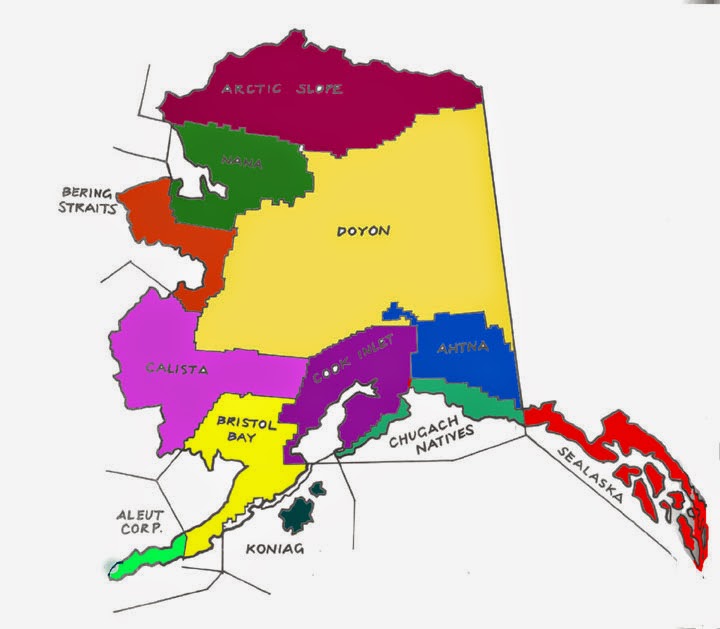
The Alaska Native Claims Settlement Act of 1971 was the largest land settlement made by the United States with an indigenous group. With the passage of the settlement the government formed 13 regional and hundreds of village Native-operated for-profit corporations in exchange for Native communities releasing their title claims to the Alaska region. Often maligned by the public, the settlement and their corporations, changed traditional cultural ways of living for Alaska Native communities in a variety of ways. This panel tracks the history of the settlement, with its origins in pre-statehood Alaska amid World War II Native alliances to the rise of the Alaska Federation of Natives through the Alaska Native Solidarity Movement. After giving consideration to the activist currents of political solidarity and their interests in maintaining traditional culture, that preceded the settlement, the panel examines how the introduction of IRA-based tribal governments in the 1990s complicated politics for the Native people, the corporations, and the State of Alaska. This is believed to be the first panel on the Alaska Native Claims Settlement Act by Alaska Native scholars at a national conference. 

Session 4      11:00 a.m. - 12:30 p.m.
Title:  A Tradition of Activism and the Alaska Native Claims Settlement Act
Room:  SUB Lobo A&B
Moderator:  Thomas Michael Swensen, Colorado State University

Holly Miowak Guise, History PhD Candidate, Yale University
Alaska Native Solidarity Movements During WWII
Maria Shaa Tlaa Williams, Associate Professor and Director, Alaska Native Studies, University of Alaska-Anchorage
Alaska Native Solidarity Movement and the Leadership Role of Nick Gray
Thomas Michael Swensen, Assistant Professor of Ethnic Studies,
Colorado State University
Impossible Sovereignties: The Alaska Federation of Natives, Native Corporations, and Tribal Governments in Alaska


December 28, 2014

Alaska Natives and the Land

In graduate school I was fortunate to study under the late Phil Frickey, Professor of Public Law at Bolt School of Law at the University of California Berkeley. My interests in Indian law drew from a research agenda involving the Alaska Native Claims Settlement Act of 1971 and its affects on indigenous relationships to land and water in Alaska. I took both Federal Indian Law I and II, as well as a semester of independent study, from him as he wrote the seminal work American Indian Law, Cases, and Commentary with his colleagues, legal scholars Anderson, Berger, and Krakoff. I found him generously patient with my general fumbling and innocent gaffs, letting me find my way through the nonlinear world of Native American law. Aside from legal study, one of the lessons he taught me was to try steering away from normative statements in my work.

One day after class he invited me up to his office to talk about a term paper. His office was a few floors up, in a converted dorm room, with a fantastic view of San Francisco bay. I sat down and he handed me the giant book Alaska Natives and the Land. I believe another student, a child of an Alaska state politician, gave the volume to Frickey and he in turn loaned it to me, indefinitely so it seems.

Cover of Alaska Natives and the Land
The humongous volume Alaska Natives and the Land composes a 565 page study of Alaska, its people, and natural resources by the Federal Field Committee on Development and Planning published 10 years after Alaska statehood in October 1968.  When open on my desk the work spreads out well over two and a half feet.


After the discovery of oil deposits in Prudoe Bay March 1968, the book served to educate congressional lawmakers about the region's indigenous people as Native leaders and activists labored with state and federal officials to come to terms with settling the issue of Native title. The book includes a marvelous 3 foot by 2 and a half foot foldable map detailing the Native communities within the state. The chart breaks down the regional areas with Native populations by size and by specifying whether the sites are predominately Native in nature (colored blue) or if they are non-indigenous sites with Native populations (red on the map).


Detail of Native community map
The book begins with an overview of Alaska Natives, moves to aspects of village life, to a chapter called Land and Ethnic Relations.


The chapter Land and Ethnic Relations discusses a regional analysis of Native identifications to indigenous territories. Since the book was a way to educate governmental leaders on Native land claims the chapter begins with a set of "pertinent" questions about Native land rights activism, like the query "Was, and is, there a definable dimension of Native ethnic territoriality?" Another intriguing question the chapter puts forth is " Did aboriginal "property rights" exist?" The narrative then argues that its findings, based from the assortment of questions, is that

"In their use of biological community for livelihood the Native people "occupied" the land in the sense of being on and over virtually all of it in the pursuit of their subsistence, but they did not "occupy" the land in any agrarian or legal sense as understood by Anglo-American Jurisprudence." 

Thus four years previous to the passage of the settlement there was an ideological argument against "Native title" even though indigenous actors themselves had been taking to the courts in regard to this matter for decades. In the exploration of the Kodiak region, the book extrapolates on the ways of Alutiiq people based on the Hubert Bancroft's History of Alaska(1886) and Ales Hrdlicka's Anthropology of Kodiak Island (1944), in the thesis that Kodiak Islanders, before the arrival of the Russians, held no reasonable form of government and simply foraged off the land and sea, "consuming anything that can be digested." These two misleading observations perhaps helped lawmakers conclude in the non-recognition of Native title during the time of settlement. 

This small read of the 565 page work lends little justice to the scope and importance Alaska Natives and the Land played in the passage of the land claims settlement and I would encourage anyone pursuing a course of research in Alaska Native geography, law, history, and culture to track down a copy. Also, Alaska Natives and the Land proves a great example of the many books written about areas of the world the US acquired through its various means. I have seen such volumes written on other national colonies such Hawaii, Puerto Rico, and the Philippines.

There are a few copies of Alaska Natives and the Land available on Amazon.


November 15, 2014

No University of the Aleut Nation: Thoughts upon hearing an interview with Claudio Saunt


The other day I listened to an interview with historian Professor Claudio Saunt on New Books in Native American Studies Podcast. The conversation between Professor Saunt, the co-director for the Center for Virtual History at the University of Georgia, and the interviewer Andrew Epstein concerned the historian's compelling new book West of the Revolution: An Uncommon History of 1776, published by W.W. Norton and Company. West of the Revolution examines 9 locations in the Americas amidst the pivotal year 1776, the founding year of the United States, by tracing the stories of people in these places as to contribute a greater understanding of the Americas at that moment in time. The work has received high praise for its creative linkages, being called "bold and inclusive" by Chicago Times reviewer Doug Kiel, among a list of other praises.

The work entails the global histories of many American groups interconnected by the year 1776. This  includes not only the colonists, who would come to call themselves Americans, but also the original Americans such as the Lakota, the Osage, and the Creek. In doing so, he makes the case for building a history decentered from the incubating nation-state for a more inclusive notion of America. For example, the work accounts the Osages' movements into Spanish controlled parts of the continent and Creek participation in Cuban trade.


In the first chapter "Soft Gold: Aleuts and Russians in Alaska," Saunt traces the history of a small group of Unangax̂ people, whom Russian colonists called Americans, then labled them Aleuts. Here he reads the story of 7 Unangax̂ men whom traveled 2500 miles with Russian funcationaries across the Bering to Eurasia. After their arrival two Aleuts decided to return home with 5 staying on to haul a cache of sea otter pelts another freezing 750 miles to the city of Irkutsk, a Russian border town. This site served as a place where the pelts of both sea otter and beaver could be sold to Chinese merchants. I recommend anyone interested in the imbrications of Unangax̂ people, and global supply chains to read this book.


During the New Books in Native American Studies interview Saunt makes the case for approaching American history in such a way as to place the nation-state along side the rest of American history. "Even today," he observes, "I think so many of us are parochial in the way we the way we imagine North America and of course the U.S. in the broader world." He suggests moving beyond the structure of feeling that American history should be defined solely in regard to the history of the United States. To allow American history to become lodged within that frail framework is "....something" he says, "we all need to fight against." History outside the systems of ideas that manufacture national experience as solitary to the history that took place throughout the continent proves paramount for the study of national history. "In a very practical sense, if we are going to write about American history, " Saunt asserts, "then we need to write about the places the United States took over." In the uncovering of this past comes an understanding that the nation-state fails to eclipse the histories of America that have long gone unnoticed due to the narrative of westward expansion as the dominant paradigm.

Great resource! (found in an Oakland bookstore)
Saunt makes the case for this approach to history by elaborating on just what institutions exist for pursuing this type of work. "There is no university dedicated to the Aleut nation," he tells Epstein, continuing to say, "the resources don't exist." The task and responsiblity to produce this broad American history sits with scholars because, he contends, "Aleut" communities are without resources to support their own research institutions. If one lends a quick read to Barbara Švarný Carlson's "There is No Such Thing as an Aleut" one can see that Saunt's case for scholars to incorporate these complex cultures and histories into American history holds the possibility enriching an already exciting field of knowledge. I think in doing so would help alleviate the formable obstacles many Alaska Natives have with seeing their historical participation in the formation and operation of the United States in Alaska. Moreover, he powerfully declares that, "If its (the project to document American history) not going to be done by the institutions in the United States then its not going to be done." In other words, he's saying that the people known as Aleuts are an important part of the United States and to iqnore their part in history is to do a remarkable disservice to their communities and to the stories that constitute the American past.

Of course "Aleut" people as Alaska Natives are part of the United States and the nation's resources are also "Aleut" resources, but I think he is suggesting that institutions throughout the nation should be supportive of projects and scholars who are pursuing the types of research programs that are inclusive of indigenous people. Speaking to that, as a graduate of Benny Benson Secondary School who went on to do this type of work I can say that countless people have selflessly extended their hands my direction and helped me cobble together a research program and a personal archive of materials. However, according to the work of Professors Alberta Jones and Jessica Bisset Perea there is still plenty of work required to bring Alaska Natives and their programs into the national academy. Yet, there are a handful of Alaska Native scholars sprinkled through the "lower-48" who are doing excellent work. Within Alaska institutions like, University of Alaska Anchorage's Alaska Native Studies Program Kodiak College's Alutiiq Studies Program The University of Alaska Southeast's Native Studies program, and University of Alaska Fairbanks' Cross-Cultural and Indigenous Studies Program are all in the midst of pushing great work forward.

I want to applaud Professor Saunt for writing this book and to New Books for the awesome interview.